New Structures in Low-Dimensional Topology Workshop 2026
Our Simons Collaboration, New Structures in Low-Dimensional Topology, aims to bring together researchers across a wide array of disciplines to make progress on deep questions in the field. Some of these questions are directly concerned with smooth manifolds in low dimensions, while others center the formal algebraic structures which intertwine with, and emerge out of studies of manifolds and cobordisms more broadly.
This workshop aims to introduce graduate students and postdocs to the foundational mathematics underlying core areas such as gauge theory, quantum topology, categorification, and 4-manifolds, and to provide entry points into current research. We will feature several lecture series and research talks by junior faculty, designed to bridge gaps between varied subfields and to catalyze new collaborations.
Quick facts
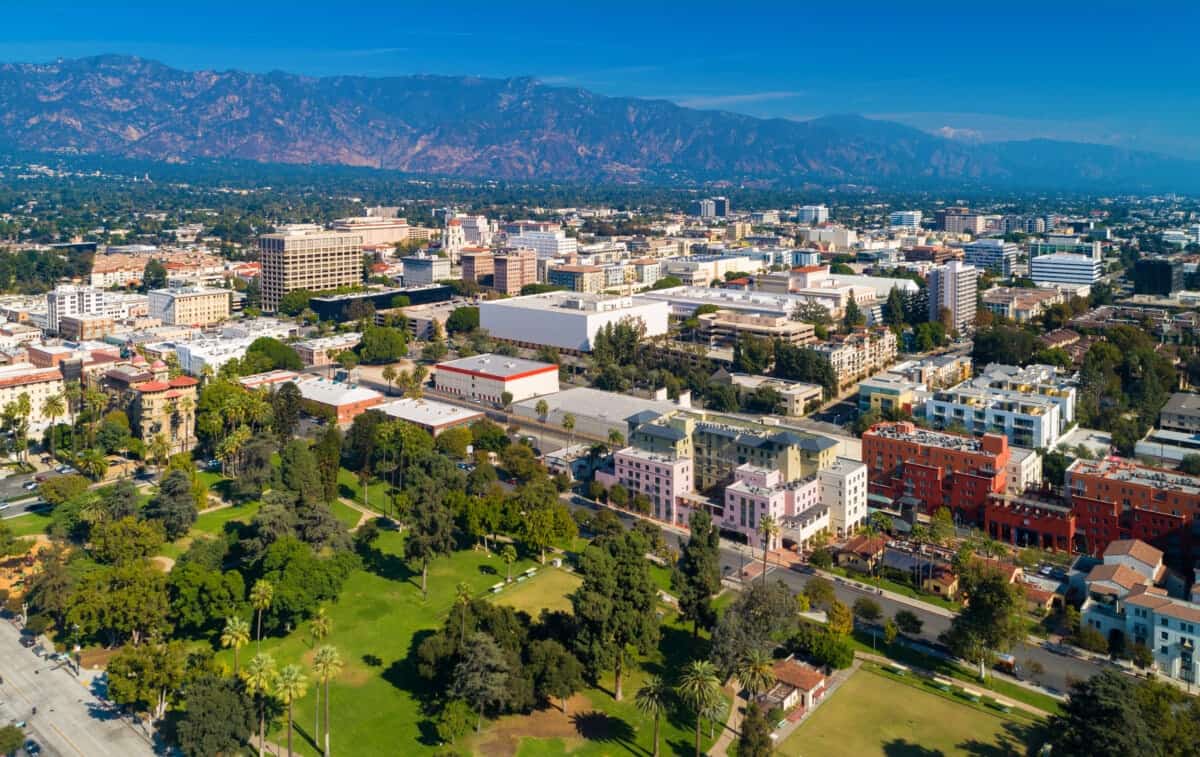
AIM is housed on the 8th floor of Caltech Hall on the campus of Caltech in Pasadena, CA.
Support and funding
- Travel & lodging: Support available for non-local participants (subject to availability).
- Grant support: Simons Collaboration Grant No. 999367.
Additional venue specifics (room, check-in procedures) will be posted when available.
Speakers
Series
- Abhishek Mallick (Dartmouth)
- Sunghyuk Park (Harvard)
- Joshua Wang (IAS & Princeton)
Research talks
- Ross Akhmechet (Columbia U)
- Melissa Zhang (UC Davis)
- Shoma Sugimoto (CalTech)
Structure and preliminary timetable
All times listed in Pacific Time unless otherwise noted. This timetable is preliminary and subject to change.
| Time | Monday | Tuesday | Wednesday | Thursday | Friday |
|---|---|---|---|---|---|
| 9:30–10:30 | Abhishek Mallick | Joshua Wang | Abhishek Mallick | Sunghyuk Park | Grad talks #2 |
| Break | Break | ||||
| 11:00–12:00 | Joshua Wang | Grad talks #1 | Joshua Wang | Abhishek Mallick | Sunghyuk Park |
| Lunch | Lunch | ||||
| 2:00–3:30 | Ross Akhmechet | Sunghyuk Park | Free! | Melissa Zhang | Shoma Sugimoto |
Symmetry, Floer theory and low-dimensional topology
Abhishek Malick
Abstract (click)
Recently there has been a lot of progress in low-dimensional topology in areas like knot concordance, homology cobordism, exotic surfaces and exotic smooth structures on 4-manifolds. One of the major driving forces behind such progress has been the use of various symmetries of manifolds. In this series, we will survey some of the Floer theoretic invariants developed for studying the actions of such symmetries and see some applications of those into the aforementioned topics in low-dimensional topology.
Fun facts about triply-graded homology
Joshua Wang
Abstract (click)
Just as most classical knot polynomials are governed by the HOMFLYPT polynomial, most modern knot homologies are governed by triply-graded homology. The three lectures will provide a tour of some highlights of the theory, with a focus on its rich structure. Each lecture will have two parts. The first parts of the three lectures will be more detail-oriented and culminate in the definition of the invariant via the Hochschild homology of Soergel bimodules. The second parts will survey a broader range of results and conjectures, with the invariant of T(n,n+1) as a case study. Topics: Bott-Samelson varieties, Rouquier complexes, qt-Catalan combinatorics, dN|M differentials, and the Hilbert scheme of points in the plane.
Annular web algebras
Ross Akhmechet
Abstract (click)
We define equivariant SL(2) and SL(3) web algebras in the annulus using annular foam TQFTs introduced in earlier work with Khovanov. To a diagram of a tangle in the thickened annulus we assign a complex of bimodules over these algebras whose chain homotopy type is a tangle invariant. I will focus on an essential part of the construction: a bijection between non-elliptic annular SL(3) webs and closed paths in the SL(3) weight lattice, generalizing an analogous bijection in the planar setting. This is based on joint work with Mikhail Khovanov and Melissa Zhang.
Quantum Topology from Dynamics
Sunghyuk Park
Abstract (click)
Dynamics studies the long-term behavior of systems that evolve over time, such as the famous Lorenz system. Quantum topology, by contrast, studies knots and low-dimensional manifolds through invariants that are usually constructed using representation-theoretic tools. In this lecture series, I will explain how quantum invariants of knots and 3-manifolds can be recovered from the dynamics of certain three-dimensional flows. Time permitting, I will also discuss how this new bridge arises from ideas in topological string theory.
Quantum topology, 4-manifolds, and categorified projectors
Melissa Zhang
Abstract (click)
Khovanov skein lasagna modules describe a smooth 4-manifold in terms of the surfaces embedded within; these surfaces have 0-dimensional singularities, thought of as 'inputs', in the following way: the boundary of a B4 neighborhood of each singularity is an S3 which the surface intersects at a link; Khovanov homology is used here to label these links at these singularities. This invariant has been used to study questions related to the Smooth Poincare Conjecture in Dimension 4; the focus of these questions is on 'exotic behavior' in 4-manifolds, i.e. the difference between being homeomorphic and diffeomorphic. While the original skein lasagna modules with 0-dimensional inputs can in some cases be computed for 4-manifolds built with only 0-, 2-, and 4-handles, it is currently not computable for 4-manifolds with 1-handles. Nevertheless, many of our known examples of exotic pairs of 4-manifolds involve 1-handles, and so there has been much interest in either finding a '1-handle formula' or developing a 1-handle-friendly version of skein lasagna modules. In this talk I will describe joint work with Qiuyu Ren, Ian Sullivan, Paul Wedrich, and Michael Willis, where we define a new version of skein lasagna modules from gl2 link homology, with 1-dimensional inputs, which is more amenable to 4-manifolds with 1-handles. The strategy is to use an isomorphism discovered in previous joint work with Ian Sullivan, where we related the skein lasagna module of S2 × D2 to Rozansky-Willis homology, a version of Khovanov homology for links in connected sums of S2 × S1. I will begin with introductions to the relevant ingredients, such as Khovanov homology, functoriality, skein lasagna modules, and the categorified projectors that are used in Rozansky-Willis homology.
An abelian categorification of Z-hat invariants
Shoma Sugimoto
Abstract (click)
The Z-hat invariant is a q-series valued quantum invariant for (negative definite plumbed) 3-manifolds introduced by Gukov-Pei-Putrov-Vafa in 2017. It provides not only a q-expansion of the Witten-Reshetikhin-Turaev invariant, but also rich examples of quantum modular forms such as mock/false theta functions. The latter fact suggests the existence of non-rational vertex operator algebras (log VOAs) with Z-hat invariants as their characters. However, the study of log VOAs is still underdeveloped, and no examples of such log VOAs have been found so far except for the two easiest cases (3- or 4-leg star graphs). This talk will outline the "nested Feigin-Tipunin constructions” introduced and developed by the speaker to provide a unified construction/research methodology of the above correspondence between log VOAs and (negative definite) plumbed 3-manifolds. It enables us to construct and study the abelian category of modules over the hypothetical log VOAs via the recursive application of the purely Lie algebraic geometric representation theory of FT construction. In particular, the corresponding Z-hat invariants are reconstructed in the Grothendieck group via the recursive application of the Weyl-type character formula of the FT construction. From a theoretical physics perspective, the nested FT constructions can be viewed as the algebraic counterpart of the 3d N=2 theory in the 3d-3d correspondence.
Tuesday grad talks
(11-11:10 am) The flip symmetry on Khovanov homologyHongjian Yang
Abstract (click)
The flip symmetry on knot diagrams induces an involution on Khovanov homology, and a folklore conjecture asserts that this map is actually trivial, at least with F_2 coefficients. We confirm this conjecture by adapting techniques from Alishahi-Truong-Zhang and Rozansky-Willis. I will explain the idea of the proof as well as some corollaries on involutive Khovanov homology and involutions on the Khovanov homology of strongly invertible knots. This is joint work with Daren Chen.
(11:15-11:25 am) A Partial Resolution of Hedden's Conjecture in the Case of Winding Number 2 mod 4
Hillary Kim
Abstract (click)
A pattern knot in a solid torus defines a self-map of the smooth knot concordance group. We prove that if the winding number of a pattern is even but not divisible by 8, then the corresponding map is not a homomorphism, thus partially establishing a conjecture of Hedden. I will discuss Lidman, Miller, and Pinzon-Caicedo’s branched cover obstruction to homomorphism inducing patterns. I will then use the branched cover obstruction to prove that a pattern does not induce a homomorphism in the case of winding number $w=2\mod 4$.
(11:30-11:40 am) Flexibility of eigenvalues of graph Laplacians
Allison Tsypin
Abstract (click)
The Laplacian matrix of a graph is given by the degree matrix minus the adjacency matrix. The spectrum of this matrix gives us information about the graph; its study is additionally motivated by interest in the Laplacian of Riemann surfaces. When these degenerate, i.e. close to the boundary of the modular space, their associated eigenvalues approach those of the discrete Laplacian on a graph obtained from the pair of pants decomposition of the surface. I provide a complete description of the sets of eigenvalues of the weighted graph Laplacian for all graphs on four vertices that correspond to a valid pair of pants decomposition of a surface of genus 3. I also present a result for complete graphs of any size, and discuss further ideas, including connections to graph suspensions. This is joint work with Alena Erchenko and Dmitry Jakobson.
(11:45-11:55 am) Spectral geometry of Khovanov Laplacians
Jernej Grlj
Abstract (click)
We will review some results about Khovanov Laplacians and introduce their motivation grounded in spectral geometry and quantum algorithms. This is joint work with A. Lauda.
(12-12:10 am) Real Seiberg-Witten Theory and Seifert Solids
Judson Kuhrman
Abstract (click)
Invariants of knotted surfaces coming from real Seiberg-Witten gauge theory have drawn recent attention due to their apparent utility for distinguishing exotic pairs. What further information can we glean from such invariants? We will discuss recent work that takes a step in the direction of this question, and use real Seiberg-Witten theory to say something about the topology of possible Seifert solids for 2-knots in the 4-sphere.
Friday grad talks
(9:30-9:40 am) Invariants from real Heegaard Floer homologyEha Srivastava
Abstract (click)
Recently introduced by Guth and Manolescu, real Heegaard Floer homology is an invariant associated to 3-manifolds equipped with an involution. In this short talk, we’ll specialize to double branched covers of links in S^3, in which case the Euler characteristic is the Heegaard Floer analogue of Miyazawa’s degree invariant. We’ll see that it can be computed inductively using a skein relation, and that it can be expressed in terms of the Alexander polynomial of the link.
(9:45-9:55 am) Real Heegaard-Floer Homology over Z
Ciprian Bonciocat
Abstract (click)
Real Heegaard Floer homology is an invariant recently defined by Gary Guth and Ciprian Manolescu, which takes as input a 3-manifold equipped with a branched cover involution. It is motivated by the desire to obtain combinatorially computable analogues of Jiakai Li's Real Monopole homology and Jin Miyazawa's Real Seiberg-Witten invariants, which were used by the latter to detect knotted projective spaces in S^4. In this talk, we discuss the issue of upgrading to Z-coefficients (which was left open by Guth-Manolescu's original paper), and its relevance to obtaining applications of similar strength to Miyazawa's results.
(10-10:10 am) Relating Kerler-Lyubashenko functors and (3+1)-skein TQFTs on 4-dimensional 2-handlebodies.
Maksymilian Manko
Abstract (click)
TQFT constructions based on non-semisimple ribbon categories are well-known to produce interesting invariants of 3-manifolds. More recently, similar strategies have been applied to 4-manifolds, notably leading to Kerler-Lyubashenko functors introduced by Beliakova-De Renzi and skein (3+1)-TQFTs due to Constantino-Geer-Haioun-Patureau-Mirand. In this talk I will explain how under appropriate assumptions invariants of 4-dimensional 2-handlebodies up to 2-equivalence deriving from these two constructions coincide.
(10:15-10:25 am) Cornered skein lasagna theory
Yangxiao Luo
Abstract (click)
The Khovanov-Rozansky skein lasagna module was introduced by Morrison-Walker-Wedrich as an invariant of 4-manifold with a framed oriented link in the boundary. I will discuss an extension of the skein lasagna theory to 4-manifolds with codimension 2 corners, and its behavior under gluing. I will also talk about a categorical framework for computing skein lasagna modules of closed 4-manifolds via trisection, as well as an extended 4d TQFT based on skein lasagna theory. This is joint work with Sarah Blackwell and Slava Krushkal.
(10:30-10:40 am) Links of Mazur manifolds and exotica
Sergey Nersisyan
Abstract (click)
We construct non-split, 2-component links of Mazur manifolds in S^4, as well as links in #^n CP^2 which are split topologically but not smoothly. As a consequence, we obtain exotic embeddings of many Mazur manifolds into S^4, as well as exotic pairs of definite 4-manifolds with boundary.
Logistics
Venue: American Institute of Mathematics (AIM), Pasadena, CA.
AIM is housed on the 8th floor of Caltech Hall on the campus of Caltech in Pasadena, CA.
Getting there
By plane
The most convenient airports for reaching Pasadena are Hollywood Burbank Airport (BUR) and Los Angeles International Airport (LAX).
- Burbank (BUR): The closest airport to Pasadena (≈25 minutes by car). Rideshare services (Uber/Lyft), taxis, and rental cars are readily available at the terminal. This is the recommended airport when possible.
-
LAX:
A major international airport with more flight options, but farther from Pasadena
(≈45–75 minutes depending on traffic).
- Rideshare / taxi: Upon arrival at LAX, follow signs to LAX-it, the designated pickup area for Uber, Lyft, and taxis. Free LAX-it shuttles run frequently from each terminal.
- Public transportation: Take the FlyAway bus from LAX to Union Station. From Union Station, take the Metro A Line toward Azusa and exit at Memorial Park Station or Del Mar Station. Both stations are within walking distance of Caltech and the American Institute of Mathematics.
By car
Pasadena is easily accessible by car via major freeways in the Los Angeles area.
- Parking at Caltech: Visitor parking is available on the Caltech campus, primarily in designated visitor lots and parking structures.
- Parking policies: Parking on campus generally requires a permit or payment at pay stations. Detailed instructions (including recommended lots and daily rates) will be provided to accepted participants prior to the workshop.
- Street parking: Limited metered street parking is available in surrounding neighborhoods, subject to posted time limits and city regulations.
We strongly recommend checking parking instructions provided by the organizers shortly before arrival, as campus parking policies may change.
Additional information
- Lodging: Saga Motor Hotel, 1633 E Colorado Blvd, Pasadena, CA 91106.
- Meals: Lunch sandwiches provided MWF. Group dinner Wednesday.
- Accessibility: Get in contact with the organizers for accessibility information.
Policies
- Code of Conduct: Please follow AIM and host-institution conduct expectations; a specific policy link can be added here.
- Recording/Photos: TBA
- Privacy: TBA